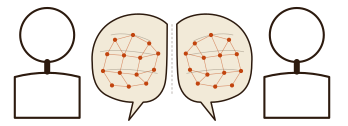

Doctor2Doctor lets clinicians send de-identified neurology or psychiatry questions by SMS and receive informal specialist input. It is for non-emergency cases where a clinician wants help thinking through next steps, referral decisions, or care while a patient waits.
Designed for clinicians managing neurology and psychiatry cases who want quick, informal specialist input.
Doctor2Doctor is a grant-supported peer advice network that lets clinicians send de-identified neurology or psychiatry questions by text. It is designed for informal specialist input when a clinician wants another perspective.
Most clinicians haven’t used a service like Doctor2Doctor before. While they might have sent an eConsult request or messaged a specialist friend, Doctor2Doctor isn’t identical to either option.
Below, we explain what the service involves, how it works, and how to use it effectively.
What Curbside Advice Means
Curbside advice refers to an informal clinician-to-clinician exchange. Usually, it involves two friends or old colleagues who speak about a case in general, in de-identified terms. One colleague might work in general practice and seek advice from a specialist. It’s a great option to support clinical thinking but does not replace a full specialist evaluation. Unfortunately, not all doctors can “phone-a-specialist” in the exact specialty they’re dealing with, or they may not want to burden a friend.
That’s where Doctor2Doctor comes in.
When to Use Doctor2Doctor
Doctor2Doctor is for cases in the process of being referred or that sit in a gray area. Such cases are not an emergency but still require another clinician’s perspective on what to do next.
Primary care physicians (PCPs) may use Doctor2Doctor:
- Before deciding whether to refer a patient to neurology or psychiatry
- While a patient is waiting for a specialist appointment
- When planning the initial workup
- When sense-checking medication or management options
- When specialist input would help, but the clinician does not have easy access to a personal specialist network, or does not want to burden their colleague and friend
When Not to Use Doctor2Doctor
Doctor2Doctor is an informal peer advice service. It is not intended for situations where a patient needs urgent assessment, formal specialist care, or management by a neurologist or psychiatrist.
It should not be used for:
- Emergencies or time-sensitive symptoms
- Cases requiring direct specialist examination
- Situations where a documented formal specialist opinion is required
- Cases where the specialist needs to review the full chart
- Any message containing patient-identifying information
- Situations where clinical responsibility needs to transfer to a specialist
How It Works
1. Send a de-identified question
A clinician signs up for the service. They can then send a focused case question via SMS text message to a network of neurologists and psychiatrists at no cost.
2. A specialist reviews it
A specialist reviews the question, formulating a practical, case-specific response.
3. Practical guidance comes back
The clinician receives informal input to support next-step thinking. They can ask follow-up questions if necessary.
What to Include in a Good Case Question
Doctor2Doctor works best when clinicians submit concise, precise questions designed to answer the most relevant questions in a patient’s case.
Example Case Questions
- “This patient’s headache pattern has changed, but there are no obvious red flags. Would you refer to neurology now, or start with additional workup?”
- “This patient has had a partial response to their current psychiatric medication. Does increasing the dose, switching, or adding another medication make more sense?”
- “The patient is waiting for neurology and may not be seen for several weeks. Is there anything you would do or monitor in the meantime?”
- “I’m not sure whether this presentation is primarily neurologic, psychiatric, medication-related, or something else. How would you think through the next step?”
How This Compares to Other Options
Doctor2Doctor is one of several ways to access specialist input. These comparisons clarify when each option makes sense.
Doctor2Doctor vs. RubiconMD and other eConsult platforms
Platforms like RubiconMD offer formal, billable specialist reviews routed through the EHR. They are appropriate when you need a documented specialist opinion included in the patient's record. Doctor2Doctor serves a different need: quick, informal peer input on cases where you want a colleague's perspective before deciding on next steps.
The funding model also differs. RubiconMD and similar platforms typically involve billing or institutional contracts. Doctor2Doctor is grant-supported and free for clinicians.
If your question is "Is this workup reasonable before I refer?" or "What do you think of this approach?", Doctor2Doctor is probably the right tool. If you need a formal documented opinion that becomes part of the chart, an eConsult platform is more appropriate.
Doctor2Doctor vs. MCPAP
MCPAP (Massachusetts Child Psychiatry Access Program) and similar state-based programs offer phone-based psychiatry access for primary care clinicians. Both programs share a similar goal: connecting frontline clinicians with specialist input to support better patient care. But there are meaningful differences in how they operate.
- SpecialtiesMCPAP focuses on psychiatry. Doctor2Doctor covers both neurology and psychiatry, including adult and pediatric subspecialties.
- Access modeMCPAP offers real-time phone support. Doctor2Doctor is asynchronous by text.
- GeographyMCPAP programs are tied to specific states and regional teams. Doctor2Doctor serves clinicians in North Dakota, South Dakota, and Montana but draws on a national specialist network.
If you are in a state with an active MCPAP program and need real-time psychiatry support, that may be a good fit for urgent questions. Doctor2Doctor is well-suited for cases where you want thoughtful input on your own timeline.
How Clinicians Use Doctor2Doctor Day to Day
Before referral
Clinicians don’t always know if a referral is needed, how urgent a case is, or what workup should be completed first. Doctor2Doctor gives them quick feedback that doesn’t slow down the process.
While waiting
It can take weeks or months before a patient sees a specialist. If anything changes or the clinician has any questions, Doctor2Doctor offers an intermediary service.
For sense-checks
From medication choice to diagnosis and management, Doctor2Doctor provides another clinician’s perspective on complex case questions.
For Specialists Using Doctor2Doctor
Doctor2Doctor can also support neurologists and psychiatrists who want informal subspecialty input or a peer perspective on challenging cases. For example, a chance to hear from an epilepsy, neuromuscular, neuroimmunology specialist.
Ready to get started?
Doctor2Doctor is currently available to clinicians in North Dakota, South Dakota, and Montana, with a nationwide specialist network.