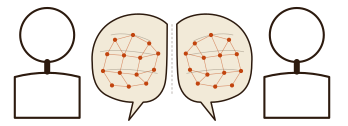

Doctor2Doctor is a grant-supported platform that allows clinicians to text neurologists and psychiatrists for informal curbside advice and second opinions. Clinicians can submit brief case questions and receive specialist input to help guide their clinical thinking, plan next steps, or decide whether a formal referral is needed. The service is designed to mirror traditional curbside conversations between colleagues — just without the hallway.
Doctor2Doctor is an informal curbside exchange, while eConsults are formal, billable medical services. A few key differences:
- Workflow: Doctor2Doctor is a simple text message, not an EHR-routed consult request.
- Documentation: No formal chart review or medical record entry.
- Billing: Grant-supported and not billable, unlike CPT-coded eConsults.
- Nature: Informal, educational peer discussion — not a formal consultation or transfer of care.
Most clinicians receive a response within 24 to 48 hours. Because Doctor2Doctor is asynchronous, specialists respond thoughtfully rather than in real time. It is designed for non-emergency cases where timely but not immediate input is helpful. If a patient has acute or time-sensitive symptoms, follow standard emergency protocols.
Doctor2Doctor is completely free for both clinicians and patients. It is a grant-supported clinical initiative aimed at improving healthcare access in rural communities. There are no subscription fees, hidden costs, or insurance billing requirements.
Doctor2Doctor is currently available to licensed clinicians in North Dakota, Montana, and South Dakota. The specialist network is nationwide. Join the waitlist to be notified when it expands to your area.
Doctor2Doctor is available to licensed clinicians, including physicians (MD/DO), nurse practitioners (NPs), and physician assistants (PAs). It is designed for clinicians actively managing patients who want informal neurology or psychiatry input. The platform is not available to patients directly.
All specialists go through a credentialing and verification process before joining the network. This includes confirming licensure and board certification. The goal is to ensure that clinicians receiving advice are connecting with appropriately trained, experienced neurologists and psychiatrists.
No — there are no required shifts, quotas, or minimum case volumes. Specialists participate on a flexible, opt-in basis and choose which cases to engage with. You can contribute as little or as much as fits your schedule.
Yes, many specialists use Doctor2Doctor as a flexible side role. Because it is asynchronous, you can respond to cases between clinical duties or on your own schedule. There are no fixed shifts, making it easy to integrate into your existing work. Semi-retired specialists with a current medical license are also welcome as an opportunity to mentor the next generation of clinicians.
Yes, multiple specialists can respond to the same case. Neurologists, psychiatrists, or subspecialists may weigh in on a single de-identified case, offering complementary or alternative viewpoints. This can be especially useful for complex cases that benefit from both neurology and psychiatry input.
Yes, specialists can join from anywhere in the United States. While the program currently serves clinicians in North Dakota, South Dakota, and Montana, the specialist network is not geographically restricted. This allows Doctor2Doctor to connect frontline clinicians with a broad pool of neurologists and psychiatrists, including subspecialty expertise.
Doctor2Doctor is designed so that no protected health information is shared. Clinicians are instructed not to include names, dates of birth, or other identifiers. All communication takes place within a HIPAA-compliant platform, every submission is reviewed before it is posted to the specialist discussion board, and any identifying information is removed.
Include relevant clinical details only, with no identifying information. Symptoms, medical history, lab results, current medications, and your specific question for the specialist are all appropriate. Do not include names, exact dates, addresses, or any other Protected Health Information (PHI).
No, Doctor2Doctor is not billable and cannot be reimbursed using CPT eConsult codes (99446–99452). Because it is an informal, educational discussion without chart review or formal documentation, it does not meet billing requirements. The service is fully grant-supported and free for both clinicians and patients.
Documentation requirements depend on your institution's policies. Because no physician-patient relationship is established and advice is general in nature, many curbside exchanges are not formally documented. Some clinicians choose to note that informal peer input was considered as part of their clinical reasoning. Follow your local documentation guidelines.
Doctor2Doctor is structured to keep specialist participation educational rather than clinical. Specialists do not interact with patients or access medical records. Advice is educational, informal, and based entirely on de-identified information provided by the treating clinician. Ultimate medical liability remains with the patient's primary provider, who is responsible for all diagnostic and treatment decisions.