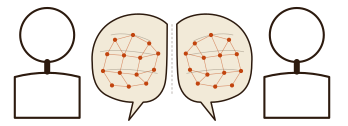
A curbside consult is quick, informal advice from another clinician. An eConsult is more structured and usually involves a formal workflow, documentation, or clinical data review. Doctor2Doctor sits closer to curbside advice: clinicians can ask de-identified specialist questions by text without starting a formal consult or referral.
If a clinician wants specialist input, they usually have a few familiar options:
- Submit a referral, even if it may not be necessary
- Ask a specialist friend for advice if they know someone
- Request an eConsult through a formal workflow
The problem is that many referrals happen because a clinician cannot get timely feedback. Most doctors do not have a trusted contact in the right specialty, and an eConsult can feel too formal for a focused clinical question. Sometimes, they just need a quick, helpful perspective.
Doctor2Doctor offers another route. It gives clinicians access to informal specialist input through a peer advice network, without starting a full referral process.
What Is a Curbside Consult?
A curbside consult refers to informal clinician-to-clinician advice. Often done via friends, it provides quick, practical guidance based on limited information. Not documented like a formal consult, it could be conducted via text, phone call, or an in-person conversation.
Great for early thinking, referral decisions, and workup questions.
When to Use a Curbside Consult
Curbside consults are most commonly used for:
- Quick sense-checks
- Early-stage clinical reasoning
- General workup questions
- Deciding whether a referral may be needed
- Cases where a full chart review is not necessary
What Is an eConsult?
An eConsult is a structured asynchronous specialist review, usually submitted via a formal platform or health system. The submitter can include clinical information, and the question may become part of the medical record.
Best suited for when documentation and patient-specific recommendations are needed.
When to Use an eConsult
eConsults are generally preferred for:
- Patient-specific recommendations
- Cases where documentation matters
- Questions requiring review of labs, imaging, or more detailed records
- Situations where the response should be part of the chart
- Health systems with established eConsult workflows
Curbside Consult vs eConsult at a Glance
| Option | Best for | What it offers | Main limitation |
|---|---|---|---|
| Formal referral | Patients who need direct specialist evaluation, testing, diagnosis, or ongoing management | Full specialist assessment and a documented care pathway | Wait times can be long, and a referral may be more than the question requires |
| Traditional curbside advice | Quick sense-checks and early clinical reasoning | Fast, informal input from a specialist colleague | Depends on personal contacts and may not be available when needed |
| eConsult | Cases needing documented specialist review | Structured, patient-specific input through a formal workflow | Can involve more admin, documentation, and system requirements |
| Doctor2Doctor | Non-emergency questions where clinicians need practical specialist input | De-identified peer advice by text, without starting a formal referral | Not a formal consult and not a substitute for direct specialist care |
Limitations of Each Approach
Neither a curbside consult nor an eConsult is best for all occasions. Curbside consults are useful for quick, practical input. However, they depend heavily on personal networks, which may be inconsistently available. The exchange does not create the same formal specialist documentation as an eConsult, and only limited information can be shared.
eConsults, on the other hand, involve a lot more workflow, often through specific platforms or systems. This process can feel too heavy for a simple question and is not always available outside certain networks.
Where Doctor2Doctor Fits
Doctor2Doctor sits somewhere in the middle. It’s closer to curbside advice than an eConsult but doesn’t rely on personal networks. Clinicians can submit de-identified neurology or psychiatry questions by text and receive informal specialist input without starting a formal consult or referral.
It keeps the speed and flexibility of a curbside consult while adding:
- Structured, asynchronous communication
- Access to a network of specialists beyond your personal contacts
- De-identified case sharing
- A more reliable workflow than ad hoc texting
Unlike eConsults, there is no formal consultation or referral workflow, with substantially less administration and documentation.
Looking for a fast, informal specialist perspective?
Doctor2Doctor gives you curbside-style access to neurologists and psychiatrists by text, at no cost.