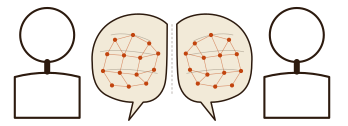

Doctor2Doctor reduces burnout by making specialist support easier to access. It gives clinicians a fast, text-based way to get peer input, avoid unnecessary back-and-forth, and move forward with more confidence. That means less administrative drag, less isolation, and fewer moments spent carrying a complex case alone.
Designed for clinicians in ND, SD, and MT who want thoughtful specialist input without adding another heavy workflow.
What Drives Burnout In The First Place?
Burnout is often less about one big failure and more about a long accumulation of friction. Clinicians get worn down when they are expected to carry complex decisions alone, wait too long for help, or spend more time navigating systems than caring for patients.
Common drivers include:
- Long waits for specialist input
- Repeated dead ends when trying to get advice
- Administrative work that crowds out clinical thinking
- Feeling isolated with difficult cases
- Uncertainty about whether a referral is even needed
How Doctor2Doctor Changes The Experience
Ask the question directly
Instead of chasing down the right person or waiting for a formal referral pathway, clinicians send a de-identified case question by text.
Get specialist input without the overhead
A neurologist or psychiatrist responds asynchronously, so the clinician can keep moving without a meeting, portal log-in, or billing workflow.
Leave with a clearer next step
Even a small amount of targeted guidance can reduce uncertainty, prevent unnecessary escalation, and make the next decision feel manageable.
Why This Helps With Burnout
Doctor2Doctor does not solve every source of burnout. It does, however, remove some of the most exhausting parts of clinical work: waiting, guessing, and reworking a plan alone.
No portal hopping, no new software, and no formal consult workflow just to ask a focused question.
Clinicians get a specialist perspective without needing to rely on personal contacts or informal favors.
When the next step is clearer, patient care moves forward and the clinical load feels more workable.
What Makes It Different
Doctor2Doctor is built around curbside advice: informal peer-to-peer clinical guidance based on limited, de-identified information. That matters because it keeps the exchange lightweight, fast, and focused on decision-making rather than documentation.
- It is asynchronous, so clinicians can ask when they have time.
- It is text-based, so there is no new platform to learn.
- It is grant-supported, so cost does not become another barrier.
- It helps clinicians stay in control of the case without carrying it alone.
Who Feels The Difference Most?
The clinicians most likely to feel relief are the ones working in high-friction settings: rural sites, small practices, and busy primary care environments where specialist access is limited and every extra step adds weight to the day.
- Primary care clinicians managing neurologic or psychiatric questions
- Clinicians in rural or resource-limited settings
- Providers balancing complex patients with limited specialty access
- Specialists who want a faster peer-to-peer way to think through tough cases
When Clinicians Use It
Doctor2Doctor is most useful at the point where someone is trying to decide what to do next.
"Is this the right next step?" "Do I need to send this patient out?" "Am I missing something obvious?"
What Doctor2Doctor Is Not
Summary
By making specialist input easier to access, Doctor2Doctor removes a few of the small but cumulative stresses that drive burnout. It helps clinicians move through difficult cases with more clarity, less friction, and a little more support.
Want to make the work feel lighter?
Join the program as a clinician or specialist and use Doctor2Doctor to get fast, low-friction peer input when it matters.
Doctor2Doctor is an educational service only. It is not a formal medical consultation. No patient-identifying information is ever shared. No billing occurs. No physician-patient relationship is established.