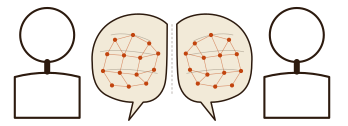
Clinicians do not always need a formal referral to get specialist input. For non-emergency questions, informal peer advice can help clarify diagnosis, workup, medication decisions, or next steps without starting a full consult process.
Doctors cannot be expected to know everything. Yet for primary care physicians, they’re the first stop for all patients. Most of the time, the patient has a chronic condition or symptoms the PCP can readily identify. Other times, the patient is clearly in need of specialist support for either diagnosis or management.
But what if the patient’s symptoms, diagnosis, or treatment fall somewhere in between? Maybe the clinician simply needs clarification? Or how to manage a particular psychiatric drug in a certain context?
What’s needed is a second opinion. Specialist input without the formal referral process.
What Clinicians Mean by a “Second Opinion”
A “second opinion” can mean a formal specialist evaluation. Often, patients use the term when asking for another doctor to look at their case.
But it doesn’t always mean that.
Clinicians may use the phrase more informally, getting another doctor’s perspective on diagnosis, workup, medication, urgency, or referral need. They may rely on a friend in a particular specialty or on formal eConsult services.
Not all PCPs have a specialist doctor on speed dial or want to go through the bureaucratic process of an eConsult. Doctor2Doctor offers a potential alternative. An informal peer advice service that offers the speed and convenience of a specialist friend without relying on old contacts.
Why Clinicians Need Another Perspective
Some cases sit in an awkward middle ground. They are not urgent enough for emergency escalation, but they could benefit from another perspective.
A patient may be waiting weeks for neurology or psychiatry, while the treating clinician still has decisions to make today. In other cases, the question may be whether a referral is needed at all, how urgent it should be, or what workup would make the referral more useful if it does go ahead.
This is especially common in neurology and psychiatry, where symptoms can be complex, access can be limited, and the “right next step” is not always obvious. In those moments, another clinician’s perspective can help clarify the plan without immediately starting a formal referral process.
When Clinicians Use Doctor2Doctor
1. Before placing a referral
To decide whether referral is needed, how urgent it is, or what workup should be completed first.
2. While a patient is waiting
To get interim guidance while neurology or psychiatry access is delayed.
3. When the case feels uncertain
To sense-check a diagnosis, medication choice, management plan, or next step.
What Doctor2Doctor Changes
Faster
Clinicians can get another specialist-trained perspective without waiting for the full referral process to play out.
Lower friction
There is no need to start a formal referral just to ask a focused clinical question.
More practical
The teaching is tied to the case in front of you, making the learning more focused than the typical educational webinar/didactic format.
How to Ask for a Useful Peer Perspective
Just having access to an informal peer advice service doesn’t guarantee a useful response. You’ll want to start with a clear focus on the clinical question: what is it you primarily want to know?
Include any relevant context, including a brief summary of symptoms, history, medications, or workup, if it relates to your question. Adding too much detail might seem thorough but can be confusing via text.
Ask for the practical next steps. You might be asking about a potential referral, medication change, diagnosis, or treatment options.
Here are some examples:
- “Would you refer this headache presentation now, or start with additional workup?”
- “Does this medication plan seem reasonable given the partial response?”
- “What would you monitor while this patient waits for neurology?”
- “Does this sound more neurologic, psychiatric, medication-related, or something else?”
Who Benefits Most
Doctor2Doctor is especially useful for clinicians who are making specialist-adjacent decisions without immediate specialist backup. That may include:
- Primary care clinicians managing broad, complex caseloads
- Clinicians in rural or specialist-limited settings
- Teams handling neurology or psychiatry questions without easy local support
- Patients waiting for specialist care while the treating clinician still needs to make decisions
What It Is Not
Doctor2Doctor is designed to support clinical thinking, but it has clear limits. It is:
- Not a formal specialist consultation
- Not a patient-facing second opinion
- Not for emergencies or time-sensitive symptoms
- Not a substitute for referral when direct specialist care is needed
- Not a place to share patient-identifying information
- Not a transfer of clinical responsibility
Final Thoughts
Doctor2Doctor is there to provide clinicians working within the community with a “second opinion”. And while solving this practical problem, it is also an opportunity for clinicians to maximize their learning from patients through specialist feedback.
Need peer input on a neurology or psychiatry question?
Doctor2Doctor connects you with specialists by text: no portal, no referral, no cost.